Restored Property Access
Quickly reopen blocked driveways, side paths, carports, and garden areas.
Post-storm tree cleanup, snapped branch extraction, and insurance-ready property clearing.
Post-storm tree cleanup across Ironbark and Greater Bendigo
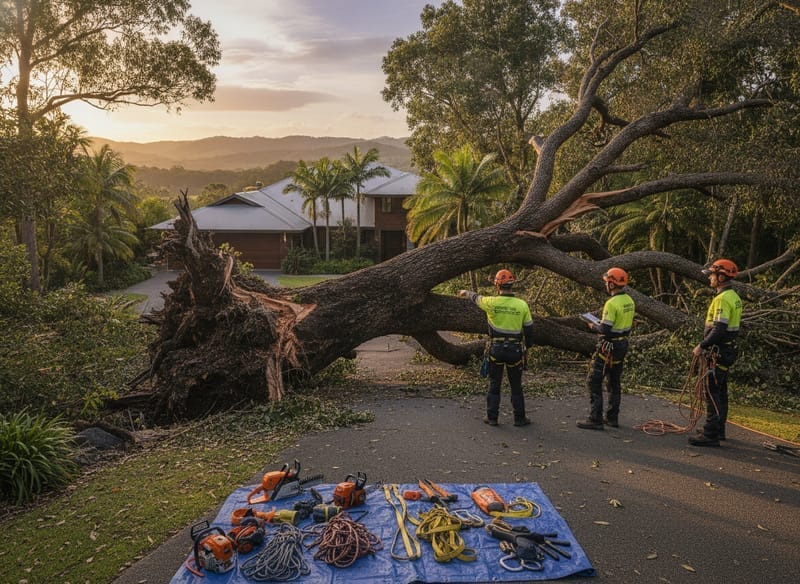
Severe weather across Greater Bendigo frequently leaves Ironbark properties littered with broken limbs, cracked trunks, and uprooted trees. Our storm damage tree removal Ironbark service provides thorough, safe cleanup and structural restoration.
Ironbark is vulnerable to fierce westerly and southerly storm fronts that hit shallow-rooted trees on ridgelines. When sodic duplex soils become saturated in late winter and spring, mature eucalypts and heavy-canopied English elms frequently suffer root-plate lifting and catastrophic canopy failure.
Quickly reopen blocked driveways, side paths, carports, and garden areas.
Prune torn stubs cleanly on surviving trees to prevent decay organisms from penetrating the trunk.
Receive clear paperwork and photo logs that simplify claims with your insurer.
We inspect your Ironbark property for broken limbs, root heave, electrical hazards, and structural tensions.
Our team cuts and rigs storm-damaged limbs to relieve tension without shifting loads onto structures.
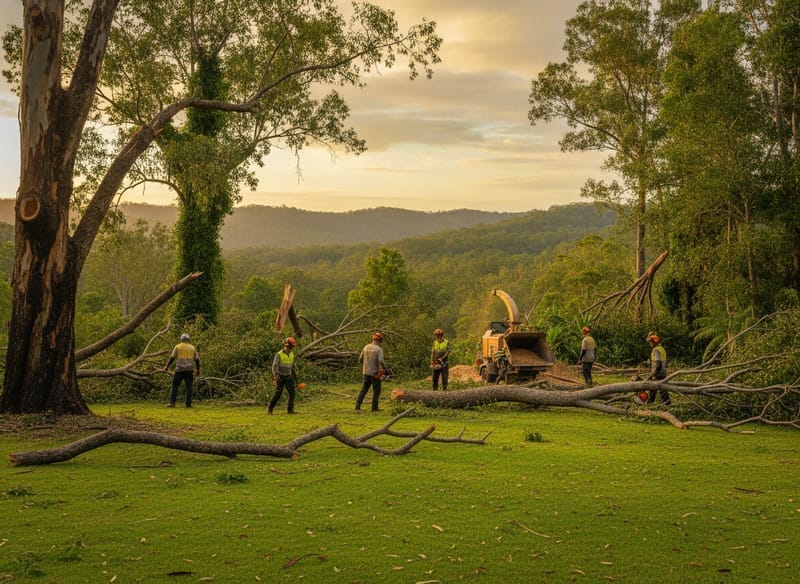
We chip all green waste into fresh mulch and cut heavy logs for firewood or transport them offsite.
We perform corrective pruning on surviving trees, removing ragged tears back to clean branch collars.
When severe weather hits our region, Storm Damage Tree Removal Ironbark becomes an priority for local homeowners, acreage properties, and property managers. Here in the heart of the goldfields, our established box ironbark canopy and heritage exotics face unique environmental challenges. The shallow, stony Ordovician sandstone and sodic duplex soils mean that tree root systems often sit on shallow plates. When heavy late-spring rains saturate the ground and high winds follow, root-plate failures and heavy limb breakages are a major risk across the suburb. At Bendigo Arborist, we provide fast, professional triage and cleanup when you need it most. Whether it is a collapsed Red Ironbark on your fenceline, a hung-up branch over your driveway, or a large English Elm that has split during a fierce summer storm, our local team is ready to respond. We understand the stress of property damage and the urgency of restoring access. We are equipped to safely remove hazardous timber, process heavy debris, and get your Ironbark property safe again. As locals, we understand the landscape, the climate, and exactly what it takes to manage storm-damaged trees on hard, stony ground.
After a destructive storm, the temptation to fire up a chainsaw and clear fallen debris yourself can be overwhelming. However, storm-damaged trees are incredibly unpredictable. A fallen tree or a snapped limb holds massive amounts of stored kinetic energy in its timber. Cutting into a trunk without understanding compression and tension wood can cause limbs to violently snap back, trapping equipment or causing fatal injuries.
Relying on under-qualified operators is equally risky. In a rush to clear sites, inexperienced workers often resort to aggressive topping or lopping. This practice leaves behind ugly stubs and damaged standing trees that will produce weak epicormic regrowth, virtually guaranteeing they will fail again in the next weather event.
At Bendigo Arborist, our AQF Level 3 climbers and ground crews strictly follow AS4373 – Pruning of Amenity Trees when dealing with retained, partially damaged trees. We use proper target and branch collar pruning to remove fractured branches, giving the tree the best chance to seal its wounds and recover safely. For completely failed trees, we execute a controlled, fully insured removal process that protects your home and infrastructure.
We deploy a systematic, highly technical triage and removal process tailored specifically to Ironbark's challenging terrain and dense canopies.
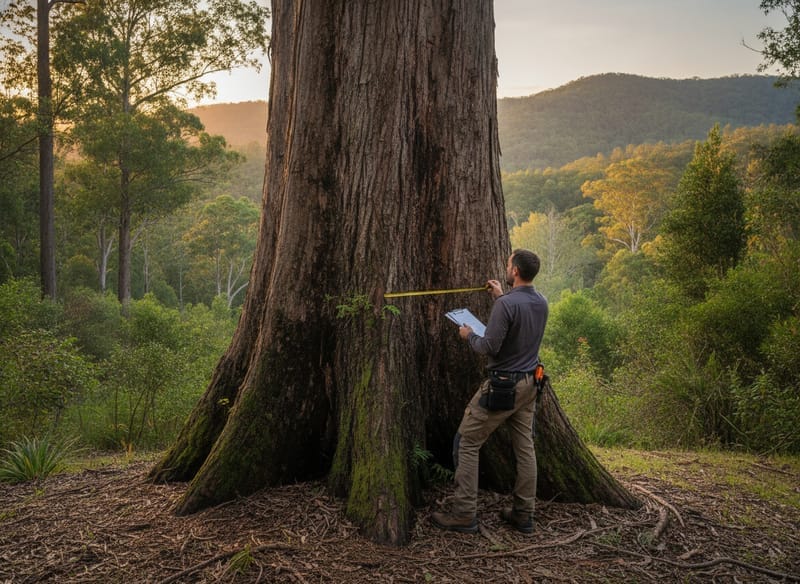
We walk the property to assess and tag trees by priority: immediate hazards over houses or powerlines, secondary hazards like hung-up limbs, and trees needing further AQF Level 5 assessment. We always secure the highest risk zones first.
Using high-powered ground saws (such as the MS461 and MS500i), our operators carefully read the binds in fallen timber. We make precise relief cuts to safely release pinned limbs and fallen trunks without dangerous snapback.
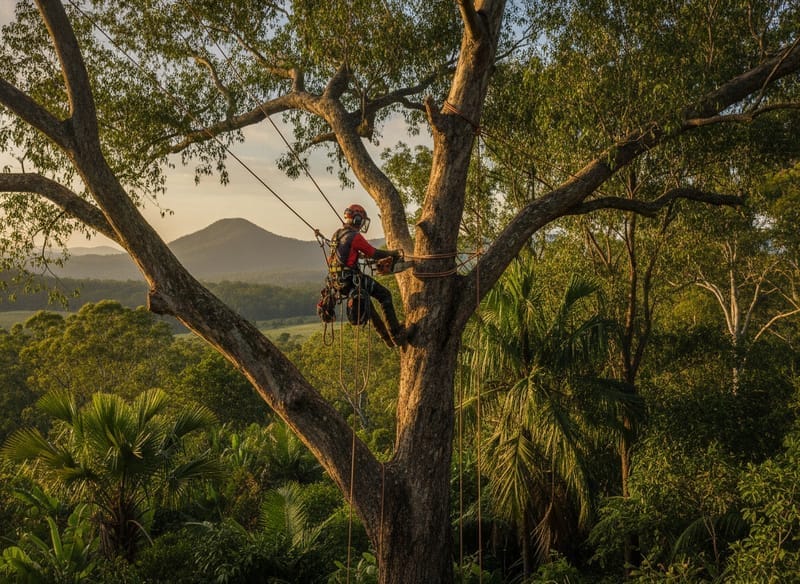
For hung-up canopy limbs where elevating work platforms cannot reach, our arborists use double-rope climbing techniques and top-handle saws to systematically rig and lower damaged branches away from your roofline.
We process smaller storm debris directly into mulch on-site using 9-inch and 12-inch capacity wood chippers. For massive Red Ironbark or Grey Box trunks, we utilise loader cranes and tipper trucks to safely lift and extract the heavy timber.
When a root plate fails entirely, we cut the stump flush and grind it 150–300mm below grade. Our operators carefully navigate Bendigo's tough buckshot gravel and sandstone fragments, maintaining awareness of any poorly mapped historical gold shafts.
Handling a weather crisis requires a calm, highly structured approach. When you call us for Storm Damage Tree Removal Ironbark, we follow a strict operational procedure to restore safety to your block as quickly and efficiently as possible. First, we conduct an immediate on-site hazard assessment. We evaluate the structural integrity of every damaged tree. If a tree has snapped but remains partially upright, we determine whether it can be salvaged through careful AS4373-compliant pruning or if full removal is the only safe option. Next, we provide a detailed, itemised quote breaking out each individual job line. Before any saws are started, we capture extensive photographic evidence of the damage. This documentation is formatted specifically for direct and easy submission to your insurance provider, smoothing out the claims process. Once approved, our crews deploy. We secure the work zone, often utilising rope access or spider lifts to navigate Ironbark's tight residential spaces. We clear immediate hazards first, systematically dismantle the broken canopy sections, process the brush, and crane out the heavy logs. We finish by thoroughly clearing the site, leaving your property safe, clean, and ready for recovery.
When dealing with hazardous storm damage, peace of mind is paramount. Our team is fully public liability and WorkCover insured, ensuring you and your property are entirely protected throughout the cleanup process. Every climber on our crew holds an AQF Level 3 in Arboriculture, while our consulting arborists hold AQF Level 5. When a damaged tree presents an immediate risk of injury or property damage, the City of Greater Bendigo allows for emergency works to make the situation safe. We act as your suitably qualified professionals, documenting the hazard and limiting our cuts strictly to the parts creating the risk, keeping you fully compliant with local regulations while satisfying your insurer.
Navigating tree removal in Bendigo requires precise local knowledge. Under the state-wide Clause 52.37 Canopy Trees regulation, permits are required for canopy trees over 5m tall located near property boundaries, though trees in the middle of a standard yard are generally exempt. However, dead native vegetation over 40cm in diameter still triggers local permit rules.
Properties in and around Ironbark are frequently covered by Significant Landscape Overlay Schedule 1 (SLO1) or Vegetation Protection Overlays (VPO), which strictly regulate the removal of native vegetation like Grey Box and Red Ironbark. Additionally, Bendigo's unique Heritage Overlay sometimes protects individual trees—such as specific English Elms—at nominated street addresses.
Our team understands these City of Greater Bendigo planning controls inside out. We ensure that any non-emergency storm cleanup is fully compliant with local laws, and we know exactly when the 10-metre bushfire clearing rule applies to pre-2009 homes in bushfire-prone areas.
Once the immediate storm damage has been cleared, it is crucial to carefully monitor the remaining trees on your property. High winds can cause microscopic fractures in branches that may not fail until weeks later. This is particularly common during hot, still summer afternoons—a phenomenon known as sudden limb drop, which frequently affects local mature eucalypts. Keep an eye on the canopy for hanging deadwood, newly split forks, or lifting soil around the base of the trunk, as soil movement indicates a failing root plate. If you notice any of these warning signs, or if you simply want a comprehensive health check for your retained trees, contact our arborists for a follow-up assessment.
Storm damage cleanup costs depend on the volume of fallen timber, structural complexity, and machinery required.
We provide clear, transparent quotes with itemised breakdowns ready for insurer submission.
We provide storm damage tree removal across Ironbark and all neighbouring Bendigo communities.
Contact our local crew for thorough storm cleanup, tree dismantling, and insurance reports.
Get a Storm Cleanup Quote